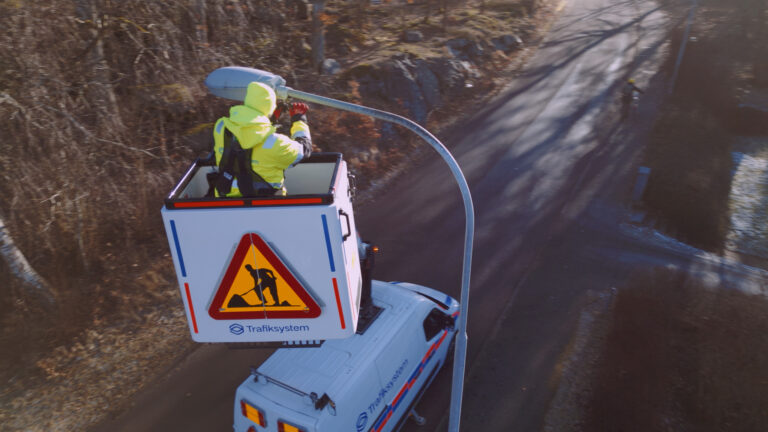
 Trafiksystem Sky Lift
Making Sweden’s roads smart and safe with Trafiksystem
Since last year, several Swedish companies have joined the Builtech Group. One of them is Trafiksystem. Based in Gothenburg, the company specialises in public transport infrastructure and, on behalf of the state and local authorities, maintains traffic lights, street lamps and other infrastructure, or implements new projects such as the construction of Tesla Superchargers across Sweden.
When winter sets in in Sweden, technology rarely comes to a standstill. Roads, traffic lights and signage there have long been responding intelligently to weather, traffic and safety. One of the driving forces behind this is Trafiksystem, a company within the Builtech Group. From simple traffic signs to AI-powered warning systems, the team led by Managing Director Lars Wiesner develops solutions that save lives – and demonstrate what digital transformation on the roads can look like.
From a company in need of restructuring to a growth engine
When Lars Wiesner joined Trafiksystem seven years ago, the company was on the brink of collapse. “It was in tatters in every respect – no strategy, no team spirit, no structure,” recalls the 62-year-old. The lawyer, who had previously spent almost three decades working in international trade – including for IKEA, Coop and H&M – took on the task of turning the company around with the composure of an experienced turnaround specialist. “I actually promised my wife I’d never be a CEO again,” he says with a laugh. “But I wanted to see if I could turn a broken business around.” Today, Trafiksystem is the most profitable company within Builtech Sweden – and continues to grow.
Three pillars, one system
The company, headquartered in Gothenburg, employs around 65 staff spread across Sweden – from Malmö to the Norwegian border, and now even in Copenhagen. Trafiksystem’s strength lies in its broad portfolio: the business is built on three pillars: public lighting, traffic signs and intelligent transport systems (ITS). Whilst competitors usually cover only one of these areas, Trafiksystem combines all three. “This allows us to react very flexibly if a market is performing poorly,” explains Wiesner. Clients are almost exclusively government institutions and local authorities, which award contracts through public tenders.
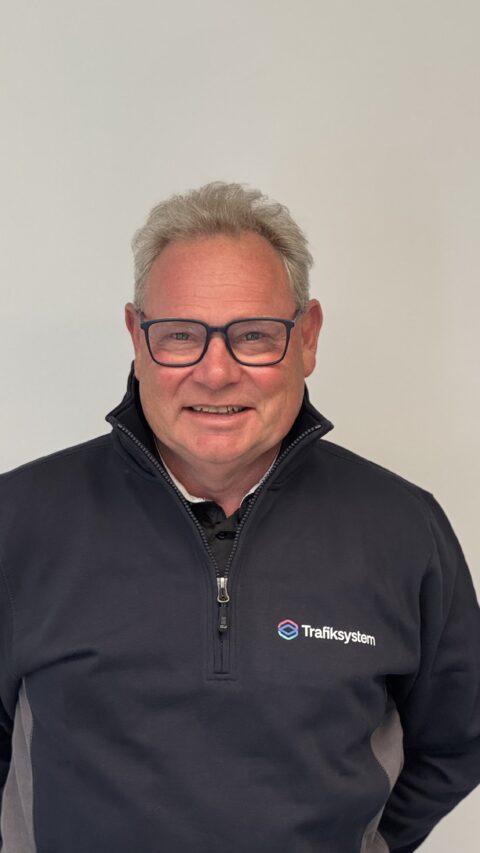 Trafiksystem CEO Lars Wiesner, Göteborg
“We were the first company in Scandinavia to use electric sky lifts”
Lars Wiesner
Trafiksystem, Gothenburg
Smart on the road
Trafiksystem has already made a name for itself in the tech world – for example, with variable speed limits that adapt dynamically to traffic conditions, or with the “Wild Warning System”. This is a camera-based AI system that detects animals on the road and automatically reduces the speed limit. “If a wild boar or a moose crosses the road, the sign reacts immediately and displays a significantly lower speed limit. In a pinch, that saves lives,” says Wiesner. It is innovations like these that demonstrate that digitalisation in road traffic is not just about efficiency, but above all about safety.
To ensure safety and maintain infrastructure across the country, Trafiksystem actually has more vehicles than staff – currently 72 to 65 – because the fleet is the teams’ key tool: from service vehicles and lifting platforms to excavators, all ready for self-sufficient operations even outside urban areas. Trafiksystem is also a pioneer when it comes to sustainability. 28 per cent of the vehicle fleet is already fully electric – next year, the figure is set to rise to 50 per cent. “We were the first company in Scandinavia to have electric Sky Lifts,” says Wiesner proudly. The fact that this also makes economic sense is demonstrated by the tenders: in Sweden, companies with environmentally friendly fleets are given preference in public procurement. No wonder that Trafiksystem also took on the installation of many Tesla Supercharger stations across the country – back when hardly anyone believed in electric mobility.
Swedish work culture
Yet the company’s success is not down solely to technical factors. Wiesner leads with an approach that is taken for granted in Sweden but is still unusual in Germany. “We don’t work top-down, but bottom-up,” he says. Decisions are made collectively, and responsibility is shared. Once a month, the company uses a digital feedback system to gauge the mood within the team. “It’s more important to me how people feel than what targets they achieve,” says Wiesner. He calls the principle he learnt from IKEA founder Ingmar Kamprath “Koll utan Kontroll” – awareness rather than control.
This approach also shapes the company culture. Trafiksystem trains young talent in partnership with schools and universities, placing a strong emphasis on personal responsibility and trust. “If you allow your employees to help shape the company, it’s not just the business that grows, but every individual too,” says Wiesner. “For me, that is the true art of leadership.” Whilst there is still much debate about hierarchies in Germany, Sweden has long since moved on. Wiesner believes that this is precisely part of the secret to the success of Swedish companies – from IKEA and Volvo to Trafiksystem. “We are allowed to make mistakes, learn from them and get back on our feet. That is our strength.”
Continue to grow
Wiesner is currently looking to the future with optimism. Trafiksystem has just secured an eight-year contract, and business is growing by up to 25 per cent. The driving force behind this is new EU regulations making the switch to LED lighting mandatory by 2027 – a market worth billions. But for Wiesner, the human aspect remains crucial: “If my staff enjoy coming to work on Mondays and go home satisfied on Fridays, then we’ve won.”
Share this post on: