“You don’t need to be the best at math”
The Berlin-based program EnterTechnik offers young women a structured orientation year in technical professions - including four internships and accompanying seminars. 80% of participants later choose training or studies in the STEM fields.
School graduation in hand – now what?
For many young women, the path into working life after school is a maze of options: vocational training, university, dual programs, internships, voluntary service. The societal pressure to make a quick and “correct” decision is immense. The EnterTechnik program provides a deliberate break and a structured compass: for one year, female school graduates explore technical – and to some extent also manual – professions in four three‑month internships. This hands‑on experience is complemented by regular seminars, workshops, and close peer exchange. Two Berlin‑based companies of the Builtech Group also participate in this initiative to inspire more women to pursue skilled trades.
This model of exploration has proven successful. Around 150 young women have completed the program in recent years, and the results are impressive: 80% of them chose technical training or a university degree in STEM afterward. EnterTechnik thus provides a valuable, practice‑oriented entry point that helps participants make well‑founded career decisions.
Out on the job
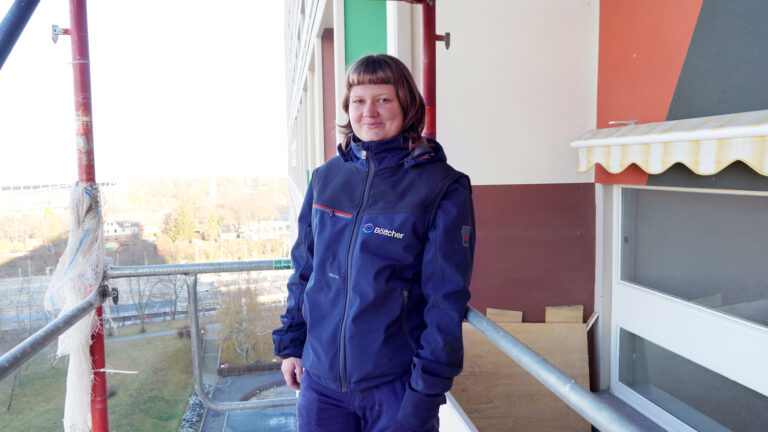
Liselotte (20) originally planned to apply to university “like everyone else” after finishing school. “I had this vague idea that I needed to do something sensible,” she recalls. Then she came across EnterTechnik and realized that an orientation year was exactly the right step – a way to avoid rushing while still moving forward.
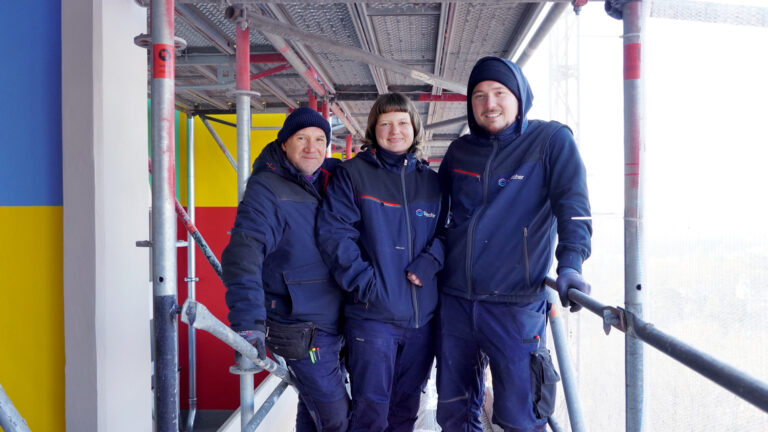
Her first internship at Jalousien Böttcher took her straight into a hands‑on work environment. With little prior exposure to manual trades, she suddenly found herself on installation jobs. She remembers her first day vividly: “I was standing on a construction site and had no idea where to start. Tools everywhere, men in high‑visibility vests, noise”. The usual questions followed: How does this work here? What am I even allowed to do as an intern?
Her experience is clear: “I was pretty much always allowed to get involved”. Even though she entered a mostly male environment, the decisive factor was the daily work atmosphere: respectful tone, and a sense of being part of the team. “That really surprised me in a positive way”, she says. At first, she had to figure out the workflows on-site. “You have to stick with it and be brave enough to ask questions”, she explains. Over time, it became routine – and that brought confidence.
What she enjoyed most: the variety. Different job sites, changing tasks, practical work instead of “just watching”. After three months, she mainly walks away with one thing: greater ease and confidence in handling tools and technology. To her, it’s no longer something abstract, but something that can be understood.
Structure instead of guesswork – and genuine support
EnterTechnik is more than “just an internship”. It is a year with a clear structure. According to Sinje Schönpflug, cooperation manager at EnterTechnik, that’s what makes the difference. Participants work full time in their companies. Once a month, they are released for seminar days. These cover excursions (e.g., to other companies or universities) and topics essential in working life: application strategies, financial independence, self assertion. Most importantly: exchange with one another. Many value these days because they can reflect on their workplace experiences – and realize others face similar questions.
The entry into the program is structured. Applications are possible year round, followed by the “Tech Casting” – a selection and introduction day. Schönpflug describes it as a “structured assessment process” where participants receive information but also complete tasks: a math test, a practical technical challenge, and teamwork exercises. “This gives the team a sense of interests, working styles, and potential – crucial to match participants with suitable companies”, Schönpflug explains.
Win-win for bothe sides
For participating companies – such as Jalousien Böttcher and B.R.A.S.S.T. Elektrotechnik – the technical year is more than an internship. It is a multi‑month, structured opportunity to get to know potential future trainees under real conditions: pace, expectations, teamwork. That’s exactly where the value lies: both sides gain clarity before making commitments.
“The chance to have experienced real workflows, real structures, real people, and to know what to expect, has a huge effect”, Schönpflug says. This equally applies to companies. Those who have already seen the job in reality start vocational training or dual studies with more realistic expectations, greater confidence, and a lower dropout risk. Schönpflug observes that graduates “rarely quit their training or studies” because they know what they’re getting into.
At the same time, the program has an internal cultural impact: companies experience firsthand that women can naturally be part of technical teams – and that diversity isn’t a “nice-to-have” but genuinely valuable. “By now, everyone knows that mixed teams are more effective, more harmonious, more dynamic – and women are simply part of that,” Schönpflug says. EnterTechnik helps make this the “new normal”. Many barriers, often mental ones, dissolve once teams actually work together.
More than tech: perspectives and confidence
The key effect often becomes visible only at the end of the year: many participants grow significantly. Schönpflug describes it as impressive to compare participants at the beginning and the end – now with “a new sense of self and confidence”. The year is a full‑time reality check immediately after school – “quite a challenge” – and that’s precisely what helps them grow. What emerges is not just a career aspiration but genuine self-assurance: “I handled this year well, I can handle everything else too”.
EnterTechnik addresses a common barrier: the idea that you must bring certain prerequisites before you’re even allowed to start. “You don’t need to be the best at math. Interest is what matters – the rest you learn”, Schönpflug summarizes.
Share this post on: